 London Intercultural
THE STORY OF ELIZA: The AI That Fooled the World
How a simple 1960s chatbot revealed the psychology of human intelligence, emotional projection and our relationship with machines.
When we think about artificial intelligence, our minds often jump to sophisticated systems such as ChatGPT, Siri and Alexa. Yet the foundations of conversational AI go back much further, to a relatively simple computer program developed in the 1960s.
Its name was ELIZA. Created by computer scientist Joseph Weizenbaum at the Massachusetts Institute of Technology (MIT) between 1964 and 1966, ELIZA could hold conversations with humans despite having no genuine understanding of language, emotion or meaning.
What made ELIZA remarkable was not what the machine could understand, but what people believed it understood.
Users began treating the program as though it possessed empathy, intelligence and even the ability to understand their personal problems. Some shared intimate thoughts with it, despite knowing they were communicating with a computer.
This unexpected reaction revealed something important about human psychology: people can perceive intelligence and emotional understanding even when the system producing the responses possesses neither.
More than half a century later, as artificial intelligence becomes increasingly sophisticated and integrated into everyday life, the story of ELIZA remains remarkably relevant.
1. What Was ELIZA?
ELIZA was one of the earliest conversational computer programs, designed to process written language and generate responses that resembled human conversation.
Weizenbaum published his work in January 1966 in Communications of the ACM, under the title ELIZA: A Computer Program for the Study of Natural Language Communication Between Man and Machine.
Unlike modern AI systems, ELIZA did not learn from enormous datasets or generate responses through neural networks. It relied on predefined rules, keyword recognition and language transformations.
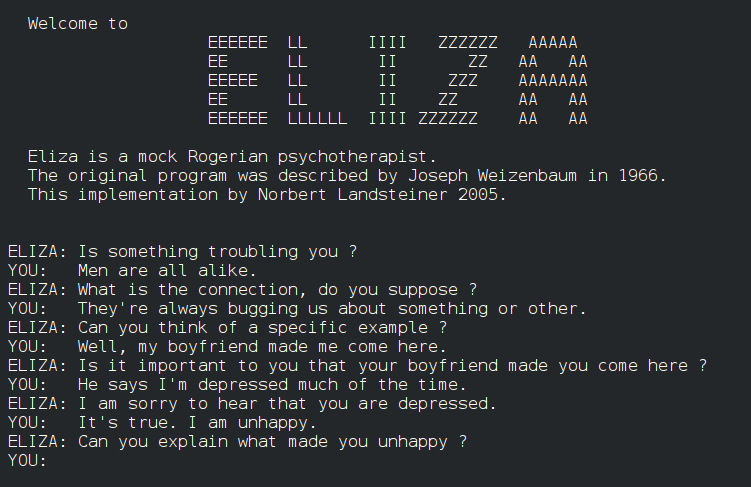
Its most famous script, called DOCTOR, simulated a Rogerian psychotherapist.
Rogerian therapy, associated with psychologist Carl Rogers, emphasises active listening, reflection and encouraging individuals to explore their own thoughts and feelings.
This made it particularly suitable for ELIZA’s design.
Rather than offering advice, the program responded to statements by asking questions, reflecting phrases or encouraging users to elaborate.
The result was a surprisingly convincing conversational experience.
2. How ELIZA Worked
ELIZA operated through a technique known as pattern matching.
The program identified keywords in a user’s message, matched them against predefined patterns and selected an appropriate response from a collection of programmed rules.
- User: I feel sad. ELIZA: Why do you feel sad?
- User: I am worried about my job. ELIZA: What does your job mean to you?
- User: My boss keeps criticising me. ELIZA: How does that make you feel?
- User: I think I might lose my job. ELIZA: What would it mean if that happened?
ELIZA was not analysing the emotional circumstances behind these statements. It was identifying linguistic patterns and applying predetermined transformations.
Consider what happens in the following exchange:
User: My father never listens to me.
ELIZA: Tell me more about your family.
The response appears relevant and thoughtful. However, the program has not understood the relationship, recognised the emotional implications or considered the user’s experiences.
It has simply applied a conversational rule.
This was the brilliance of ELIZA’s design. By using relatively simple linguistic techniques, Weizenbaum demonstrated that a computer could create the appearance of meaningful dialogue.
The underlying technology was limited. The human reaction was anything but.
3. The ELIZA Effect: When Humans Project Intelligence Onto Machines
One of the most fascinating outcomes of ELIZA was the psychological response it generated.
Despite understanding that they were interacting with a computer, some users began attributing human qualities to the program.
They believed it was listening, understanding and responding to their emotions.
This phenomenon became known as the ELIZA effect.
The term describes the tendency to attribute understanding, intelligence, emotions or human-like intentions to computer systems based on their conversational behaviour.
The phenomenon is not simply about being fooled by technology. It reveals how human perception works.
We routinely interpret behaviour through familiar social expectations. When something communicates in a way that resembles a human being, we naturally begin applying some of the same assumptions we use in human relationships.
Three psychological mechanisms help explain why this happens.
3.1 Anthropomorphism: Giving Machines Human Qualities
Anthropomorphism is the tendency to attribute human characteristics, intentions and emotions to non-human entities.
People do this in everyday life.
They talk to pets as though they understand every word, give names to their cars and sometimes become frustrated with computers as though the machines were deliberately refusing to cooperate.
Conversational AI makes this tendency even stronger.
When a system uses natural language, responds to questions and acknowledges emotional statements, it activates familiar social expectations.
The interaction begins to feel less like operating software and more like communicating with another person.
3.2 The Illusion of Understanding
Humans often judge intelligence through observable behaviour.
If something responds appropriately, remembers information and appears to follow a conversation, we may assume that deeper understanding exists behind its behaviour.
This is particularly powerful in language.
A response does not necessarily need to be sophisticated to feel intelligent. Sometimes a well-timed question is enough to create the impression that someone understands us.
ELIZA demonstrated how easily conversational fluency could be mistaken for comprehension.
It exposed an important distinction between appearing to understand and actually understanding.
3.3 Emotional Projection and the Need for Connection
People do not approach conversations as neutral information-processing exercises.
They bring expectations, experiences, emotions and personal needs.
Someone seeking reassurance may interpret a reflective question as empathy. Someone experiencing loneliness may find comfort in a system that consistently responds without interruption or judgement.
The user contributes meaning to the interaction, sometimes attributing emotional depth that the machine itself does not possess.
This is particularly interesting in therapeutic settings, where people are actively looking for understanding, reassurance and acceptance.
ELIZA showed that the experience of being understood can be influenced as much by the person receiving a response as by the system producing it.
4. What ELIZA Revealed About Human Intelligence
ELIZA raises a question that extends far beyond artificial intelligence:
Do we recognise intelligence itself, or do we recognise behaviours that we associate with intelligence?
Consider two people having a conversation.
One offers thoughtful questions, remembers details and responds in a way that makes the other person feel heard.
The other does precisely the same thing, but without genuinely understanding the conversation.
From the recipient’s perspective, the interactions might initially feel almost identical.
This highlights an interesting feature of human social perception: we cannot directly observe another person’s thoughts. We infer them from behaviour, language, expressions and context.
The same interpretive process can be applied to machines.
Explore the related discussion in LIA’s article on HAL 9000: Why Humans Fear Intelligent Machines.
However, this does not mean that human intelligence and machine-generated language are equivalent. It means that our methods of judging intelligence can sometimes be unreliable.
ELIZA exposed the gap between three different things:
- Capability: What a system can actually do.
- Perception: What people believe the system can do.
- Attribution: The intentions, emotions and understanding people assign to it.
These distinctions are increasingly important as AI becomes more capable of producing convincing human-like interactions.
5. From ELIZA to ChatGPT: What Has Actually Changed?
The journey from ELIZA to modern generative AI represents a significant transformation in computing.
Although both operate through language, their underlying architectures and capabilities are fundamentally different.
| Dimension | ELIZA (1966) | Modern generative AI |
| Architecture | Rule-based programming | Large neural networks |
| Language processing | Keyword matching and transformations | Statistical language modelling |
| Responses | Predefined patterns | Dynamically generated |
| Context | Very limited | Can process extensive conversational context |
| Learning | No independent learning | Trained on large datasets |
| Reasoning | No meaningful reasoning capability | Can perform complex reasoning tasks, with limitations |
| Adaptability | Restricted to programmed scripts | Much broader range of tasks and subjects |
Modern AI systems are not simply more sophisticated versions of ELIZA.
They are built using fundamentally different approaches, including machine learning, deep learning and transformer architectures.
Large language models are trained to identify patterns in enormous collections of data and generate responses based on those patterns.
They can summarise documents, write computer code, analyse information, translate languages and assist with complex problem-solving.
Nevertheless, their capabilities should not be confused with human consciousness or emotional experience.
A system can generate a thoughtful response without experiencing the emotions it describes.
It can discuss empathy without necessarily feeling empathy.
And it can produce convincing explanations while still making factual errors.
The technology has advanced enormously. The psychological challenge of interpreting its behaviour, however, has not disappeared.
6. The ELIZA Effect in Modern AI
Today, the ELIZA effect is particularly relevant because modern AI systems are significantly more convincing than their early predecessors.
Unlike ELIZA, contemporary conversational systems can maintain context, refer to earlier statements, adapt their communication style and generate responses that appear highly personalised.
These capabilities make interactions more natural.
They also introduce new psychological considerations.
Trust and Perceived Authority. People may assume that an AI system is correct because it communicates confidently and presents information clearly. However, confidence in language does not guarantee accuracy. This creates a risk of over-reliance, particularly when AI is used for research, professional advice or decision-making.
Emotional Attachment. Conversational systems can provide consistent interaction, personalised responses and an experience of being heard. For some users, this can create emotional attachment. The important distinction is between the emotional experience of the user and the actual emotional capabilities of the system.
The Authority of Fluency. Well-structured language can create an impression of expertise. A system that explains something clearly may appear more knowledgeable than one that communicates uncertainty. This is a psychological trap worth recognising. People should evaluate the quality of information, not simply the confidence or sophistication of its presentation.
Human Judgement and Critical Thinking. As AI becomes more integrated into everyday activities, people must learn when to trust its outputs, when to question them and when human judgement is essential. AI literacy therefore involves more than understanding how to operate a technology. It also requires understanding how people respond to that technology.
7. The ELIZA Effect in the Workplace: Why Business Leaders Should Care
The implications of ELIZA extend well beyond technology and psychology.
They are increasingly relevant to organisational behaviour, leadership, employee development and business decision-making.
Consider a manager using an AI assistant to evaluate employee performance.
The system produces a detailed assessment, identifies behavioural patterns and recommends improvements.
Because the response is structured and confident, the manager may assume that the assessment is objective.
But what happens if the underlying information is incomplete, biased or incorrectly interpreted?
The problem is not necessarily the technology itself. It is the human tendency to assign authority to something that appears intelligent.
- 1. AI confidence is not the same as accuracy. Employees and managers must understand that fluent responses can still contain errors.
- 2. Human judgement remains essential. AI can support decisions, but accountability for important organisational decisions should remain appropriately with people.
- 3. Emotional intelligence becomes more important, not less. As machines become better at simulating human communication, understanding genuine human behaviour, relationships and emotional needs becomes increasingly valuable.
- 4. AI literacy must include psychological literacy. Organisations should teach employees not only how to use AI tools but also how to recognise their limitations and understand their own cognitive biases when interacting with them.
The lesson is straightforward: the more convincing technology becomes, the more important critical thinking becomes.
For a practical organisational perspective, see LIA’s AI Literacy Training for Employees.
8. A Brief History of Conversational AI
1950s – The Foundations. Alan Turing publishes Computing Machinery and Intelligence in 1950, introducing the imitation game, later widely known as the Turing Test. The paper reframes the question of machine intelligence around observable conversational behaviour.
1960s – ELIZA. Joseph Weizenbaum develops ELIZA at MIT. Its DOCTOR script demonstrates how simple linguistic rules can create the appearance of meaningful human conversation.
1970s – PARRY. Developed by psychiatrist Kenneth Colby in 1972, PARRY simulates aspects of paranoid thinking using a more elaborate internal model than ELIZA. It becomes another important experiment in human-machine communication.
1980s – Early Conversational Experiments. Research into natural language processing and conversational systems continues, laying foundations for more structured approaches to computer dialogue.
1990s – ALICE. Richard Wallace begins developing ALICE (Artificial Linguistic Internet Computer Entity) in 1995. Its use of Artificial Intelligence Markup Language (AIML) demonstrates how conversational responses can be organised through structured patterns.
2000s – Chatbots Enter Everyday Life. SmarterChild, launched in 2001, brings conversational bots into messaging platforms, allowing millions of users to interact with automated systems in familiar digital environments. IBM also begins its Watson question-answering project in 2006.
2010s – AI Goes Mainstream. Apple introduces Siri in 2011, bringing voice-based digital assistance to mainstream consumers. IBM Watson wins the television quiz competition Jeopardy! in 2011. Microsoft’s Tay experiment in 2016 exposes the risks of allowing conversational AI to learn from uncontrolled public interactions. Google Assistant also launches in 2016.
2020s – Generative AI. OpenAI introduces GPT-3 in 2020, demonstrating the capabilities of large-scale generative language models. ChatGPT launches in November 2022, making conversational generative AI accessible to a global audience. GPT-4 follows in March 2023, advancing capabilities in reasoning, language and multimodal processing.
The progression from ELIZA to modern generative AI represents a fundamental change in how humans interact with computers: from issuing instructions to engaging in increasingly sophisticated dialogue.
For further context on the imitation game and behavioural tests of machine intelligence, read The Turing Test: Can AI Pass as Human?.
9. The Real Lesson of ELIZA: AI Reveals as Much About Humans as It Does About Machines
There is an interesting irony in the story of ELIZA.
Joseph Weizenbaum created a relatively simple program to explore communication between humans and computers. Yet the most significant discovery was not necessarily technological, It was psychological.
ELIZA demonstrated that people could attribute understanding, intelligence and emotional qualities to a machine based on relatively superficial conversational behaviour.
Weizenbaum was deeply concerned by how readily people placed trust in the program. His later book, Computer Power and Human Reason (1976), explored the wider ethical and social implications of allowing computers to take on roles traditionally associated with human judgement.
Today, we find ourselves facing a much more sophisticated version of that challenge.
Artificial intelligence can write, analyse, advise, explain and simulate aspects of human interaction. Its capabilities are expanding rapidly, and its influence on education, business and society will continue to grow.
But the fundamental question remains:
Just because something communicates like it understands us, does that mean it does?
Perhaps the greatest lesson of ELIZA is that understanding artificial intelligence requires us to understand ourselves first.
As technology becomes increasingly human-like, the ability to distinguish genuine understanding from convincing behaviour, reliable information from confident presentation, and human judgement from automated output will become essential.
The future of AI literacy is therefore not just about teaching people how machines work.
It is about teaching people how to think when interacting with them.
Further Reading and References
- Weizenbaum, J. (1966). ELIZA: A Computer Program for the Study of Natural Language Communication Between Man and Machine. Communications of the ACM, 9(1), 36–45.
- Weizenbaum, J. (1976). Computer Power and Human Reason: From Judgment to Calculation. W. H. Freeman.
- Natale, S. (2021). The ELIZA Effect. In Deceitful Media: Artificial Intelligence and Social Life after the Turing Test. Oxford University Press.
- Weizenbaum Institute – Exhibition: ELIZA.
- PARRY: The 1972 Chatbot and Its Place in AI and Mental Health (LIA).
About This Article
This article explores the historical, technological and psychological foundations of conversational artificial intelligence, with particular attention to human perception, cognitive biases and the implications of AI adoption in modern organisations.