 London Intercultural

NHS Staff Burnout and Stress: Latest Statistics and What They Mean
More than four in ten NHS staff in England say work-related stress made them unwell last year. More than half went to work anyway when they weren’t well enough to do their jobs. Put together, those two figures from the 2025 NHS Staff Survey describe a workforce that is struggling and doesn’t feel able to say so.
This article sets out the latest figures and shows which professions are under the most strain. It then explains why we see NHS burnout as a result of how the work is organised, not a failure of individual resilience. It ends with what managers can realistically change, and what they can’t.
According to the 2025 NHS Staff Survey for England, published in March 2026, the figures are quite concerning.
Latest national figures
- 42.36% of NHS staff felt unwell due to work-related stress, during the previous 12 months.
- 31.47% of NHS staff reported feeling burnt out because of work.
- 56.01% went to work despite not feeling well enough to perform their duties, during the previous three months.
Which NHS professions are most affected?
Percentage reporting that they felt unwell due to work-related stress (2025):
| Profession | 2025 |
|---|---|
| Ambulance staff | 54.19%* |
| Registered nurses & midwives | 46.02%* |
| Nursing assistants | 44.15%* |
| Medical & dental staff | 42.42%* |
| Allied health professionals | 41.08%* |
| Admin & clerical | 37.57%* |
*NHS Staff Survey, National results briefing
Has it improved?
| Year | Work-related stress |
|---|---|
| 2021 | 47.08% |
| 2022 | 44.91%* |
| 2023 | 41.82%* |
| 2024 | 41.65% |
| 2025 | 42.36% |
What’s changed in 2026
The 2026 national staff survey has not been published yet. Recent 2026 evidence from specific groups points the same way:
- Doctors in training: In the GMC’s 2026 National Training Survey, 61 per cent of doctors in training and 47 per cent of doctors in trainer roles were at moderate to high risk of burnout. Both figures are unchanged from 2025. (BMA coverage)
- Doctors and presenteeism: The BMA’s January 2026 report found fear of letting down colleagues or patients among the main reasons doctors keep working while unwell. (BMA report)
- Healthcare staff (union survey): UNISON’s survey ran from 27 January to 27 February 2026 and reached 19,356 staff across England, Scotland and Northern Ireland. It is a union sample, so it does not represent the whole workforce. (UNISON)
The organisational psychology angle
There is an interesting problem here: more than 4 in 10 NHS employees report becoming unwell because of work-related stress, while more than half report working when they are not well enough.
This raises questions about:
- Psychological safety and whether employees feel able to disclose difficulties.
- Leadership behaviour and managerial support.
- Workload, staffing and organisational design.
- Presenteeism and its impact on patient safety.
why is this happening?
The NHS burnout problem is largely a consequence of how the organisation operates, rather than simply a problem of individual employees being unable to cope with pressure.
There is a deeper organisational psychology issue here: the NHS is asking people to sustain levels of performance that its working environment often makes difficult to sustain.
At LIA we would look at this through seven interconnected causes.
1. Chronic understaffing and excessive workload
This is probably the most obvious structural contributor.
When departments are understaffed:
- Existing employees absorb the work of missing colleagues.
- Breaks get shortened or skipped.
- Employees have less time to complete tasks properly.
- Managers spend more time managing shortages than supporting their teams.
- Recovery between demanding shifts becomes increasingly difficult.
The important distinction is between occasional pressure and chronic pressure.
People can tolerate intense periods of work. They struggle when intensity becomes the normal operating condition.
2. Lack of control over working conditions
Psychologically, people need some degree of autonomy.
NHS employees may have limited control over:
- Their shift patterns.
- Workload allocation.
- Patient numbers.
- Breaks and holidays.
- How much time they can spend with individual patients.
High responsibility combined with low control is a particularly difficult psychological combination.
An employee can be held accountable for outcomes without having sufficient influence over the conditions that determine those outcomes.
3. Emotional labour and compassion fatigue
This is especially relevant to healthcare.
Imagine repeatedly dealing with:
- Patients in pain.
- Death and bereavement.
- Distressed families.
- Aggressive or abusive patients.
- Difficult ethical decisions.
- Situations where you know what a patient needs but cannot provide it because of resource limitations.
Healthcare professionals are expected to regulate their own emotions while helping other people regulate theirs.
That takes psychological energy.
And unlike physical fatigue, emotional exhaustion is not always visible to colleagues or managers.
4. Poor management and lack of psychological safety
This is where organisational psychology becomes particularly interesting.
Employees may feel unable to:
- Challenge unrealistic workloads.
- Admit that they are struggling.
- Report mistakes without fear.
- Disagree with senior clinicians or managers.
- Ask for support without being perceived as incapable.
When employees stop speaking openly, management loses access to important information about the actual condition of the organisation.
The result is a dangerous feedback loop: problems remain hidden until they become sickness absence, resignations, errors or formal complaints.
5. Workplace bullying, aggression and lack of respect
This is a substantial issue in healthcare.
The 2025 NHS Staff Survey found:
- 25.25% experienced harassment, bullying or abuse from patients, service users or the public.
- 14.47% experienced at least one incident of physical violence from patients or the public. [NHS England+1]
Staff are effectively expected to provide compassionate care in environments where they may themselves experience aggression and mistreatment.
That creates a serious emotional contradiction.
6. The moral distress problem
We think this deserves particular attention.
Moral distress occurs when someone knows what they believe is the right thing to do but feels unable to do it because of organisational constraints.
Consider a nurse who:
- Knows a patient needs more attention.
- Has several other patients requiring care.
- Cannot spend enough time with any of them.
- Goes home feeling that they have failed someone.
The employee may be professionally competent, committed and emotionally resilient.
But repeated exposure to situations where they cannot deliver the standard of care they believe patients deserve can become psychologically damaging.
This is different from simply having too much work.
It is the psychological cost of being prevented from doing your job properly.
7. The organisation isn’t adequately responding
Here is a particularly revealing statistic from the 2025 survey.
Only 54.8% of staff agreed that their organisation takes positive action on health and wellbeing, down from 57.05% the previous year. [The NHS Alliance+1]
This creates a potential organisational cycle:
- Staff shortages and rising demand
- Increasing workload and emotional pressure
- Stress, sickness absence and burnout
- More pressure on remaining employees
- The cycle repeats
The government’s own engagement research identified staff shortages, unmanageable workloads and stressful working environments as major problems. [GOV.UK]
Our assessment: the real organisational psychology problem
We would group the causes into three levels:
| Level | Underlying problem |
|---|---|
| Individual | Emotional exhaustion, compassion fatigue, insufficient recovery |
| Management | Poor support, limited autonomy, inadequate communication and psychological safety |
| Organisational | Staffing shortages, demand exceeding capacity, financial constraints and ineffective workforce design |
These levels interact. Treating only the individual is unlikely to resolve the underlying problem.
For example, giving employees a mindfulness workshop while leaving their workload unchanged may help some people temporarily, but it doesn’t fix the working conditions.
The Psychology of Sustainable Healthcare Teams
Potential components:
- Psychological safety in high-pressure healthcare environments.
- Emotionally intelligent leadership.
- Recognising and addressing compassion fatigue.
- Moral distress and ethical decision-making.
- Managing conflict and emotionally demanding interactions.
- Building psychologically sustainable teams.
The positioning matters enormously as this is about helping organisations understand how their people respond to pressure, how managers influence those responses, and what can realistically be changed.
One distinction we would investigate further: how much of NHS burnout is attributable to poor organisational design, and how much is attributable to management behaviour?
The NHS Lack of control over working conditions
Lack of control is one of the more addressable contributors to workplace stress. But there is an important distinction between giving employees more control and giving them control over things the organisation cannot realistically change.
Let’s unpack it.
What could the NHS actually change?
NHS can consider five relatively practical interventions.
| Problem | Possible intervention |
|---|---|
| Employees have little say over shifts | Greater employee-led shift scheduling |
| Breaks are frequently interrupted | Protected breaks with operational cover |
| Workload feels imposed | Team-level workload allocation |
| Employees cannot challenge decisions | Structured employee voice and challenge mechanisms |
| Staff have little influence over processes | Frontline participation in operational decisions |
None of these necessarily requires a massive organisational transformation.
The psychology behind it
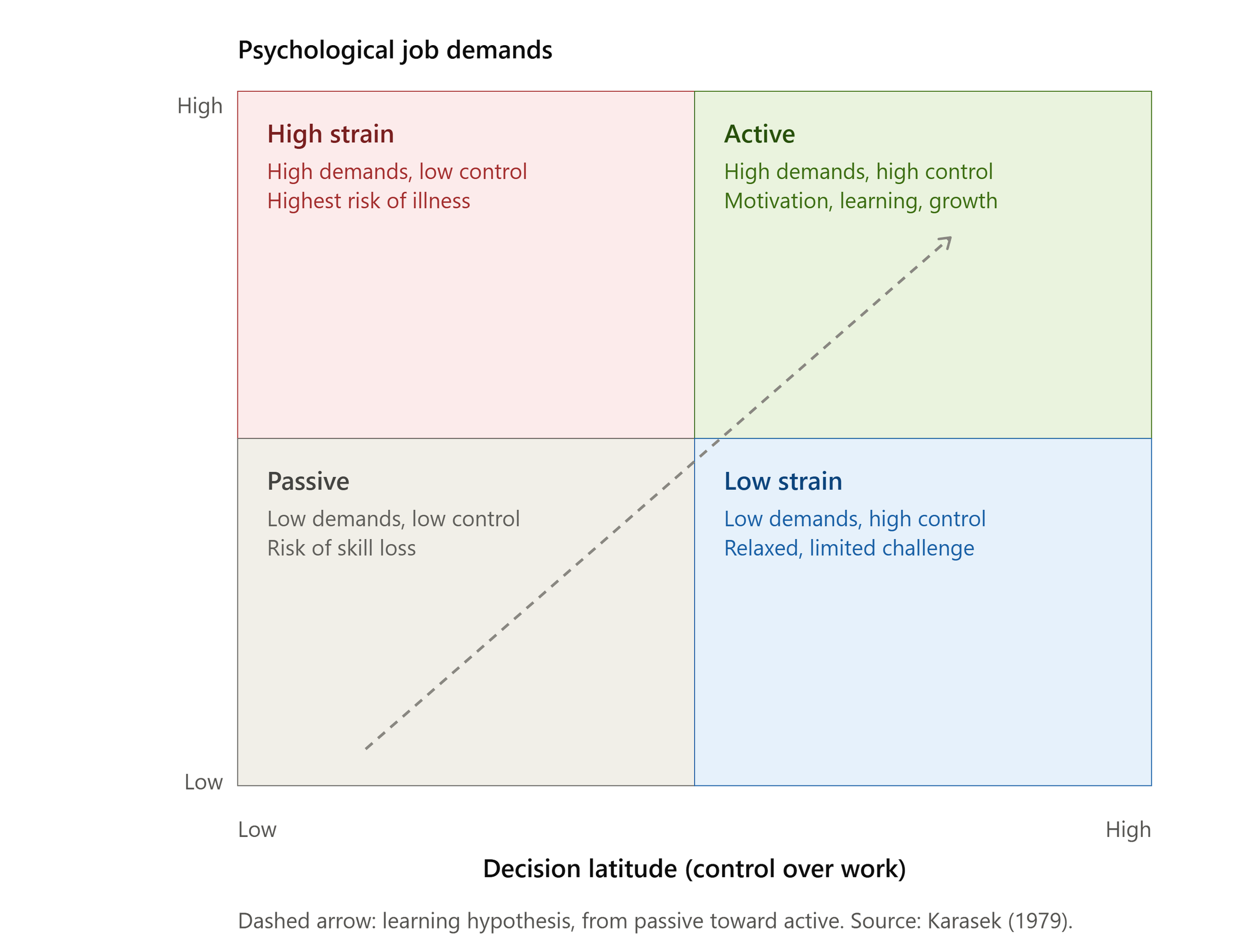
One useful framework is the Job Demand-Control model, developed by Robert Karasek.
It proposes that occupational strain is particularly high when employees experience:
- High job demands.
- Low decision-making latitude.
Karasek’s job demand-control model maps work stress into four quadrants: high strain, active, low strain, and passive.
Think about two nurses doing essentially the same job.
Nurse A
- Has little influence over scheduling.
- Cannot influence workload distribution.
- Has limited flexibility.
- Is expected to follow rigid procedures without input.
Nurse B
- Has some influence over scheduling.
- Participates in workload allocation.
- Can raise concerns and influence decisions.
- Has autonomy over appropriate aspects of patient care.
Their workload might be similar, but their experience of that workload can be very different.
Autonomy can change how people experience demands.
But here’s where it gets interesting.
Why don’t organisations implement these relatively straightforward interventions?
we would investigate four barriers:
- Management culture: Some managers interpret employee autonomy as loss of managerial authority.
- Operational complexity: Healthcare requires continuous coverage, specific competencies and coordinated shifts.
- Institutional bureaucracy: Decisions about staffing and scheduling can involve several layers of approval.
- Perceived risk: Managers may fear that flexibility creates inconsistency or compromises patient care.
There is also a fifth issue: sometimes managers themselves have very little control. They are operating within budgets, staffing limits and targets imposed from above.
We need to distinguish between three types of control:
- Operational control: How employees organise and perform their work.
- Scheduling control: When and where they work.
- Strategic control: How resources, staffing and organisational priorities are determined.
The first is often relatively easy to improve. The second requires coordination. The third can require substantial structural change.
so what can we do about this?
We would approach this as an organisational performance problem, not a conventional employee wellbeing problem.
If we were positioning LIA to the NHS, we would recommend a credible, measurable and operationally useful programme that helps healthcare organisations identify and reduce the management and workplace conditions contributing to employee stress, burnout and disengagement.
1. What is the actual solution?
The solution should be built around five interventions.
1. Give employees meaningful control
Introduce participative shift planning, protected breaks, team-level workload discussions and greater autonomy over appropriate work decisions.
Desired outcome: Greater perceived control and reduced avoidable frustration.
2. Improve management behaviour
Train managers to recognise overload, respond to concerns, distribute work fairly, manage conflict and support employees without creating fear.
Desired outcome: Better manager support and earlier intervention.
3. Build psychological safety
Create conditions in which staff can raise concerns, admit mistakes, challenge unrealistic expectations and request support.
Desired outcome: Earlier identification of organisational problems.
4. Address emotional and moral distress
Equip managers and teams to recognise compassion fatigue, emotionally demanding interactions and distress arising from being unable to provide the care they believe is necessary.
Desired outcome: Better support, appropriate escalation and healthier team practices.
5. Measure and redesign working practices
Examine staff feedback, sickness absence, workload distribution, turnover and management practices. Identify changes that teams can implement.
Desired outcome: Evidence-led organisational improvements rather than isolated wellbeing activities.
How to approach the problem and execute solutions
The NHS needs three components, delivered across one 8-week pilot.
Component A: Diagnose (week 0)
Workplace Stress and Team Effectiveness Diagnostic:
- Anonymous employee pulse survey
- Structured listening sessions
- Manager behaviour assessment
Deliverable: an organisational findings report and prioritised action plan. This is the baseline for the week 8 evaluation.
Component B: Develop (weeks 1–4)
Healthcare Leadership and Psychological Safety Academy: four 2-hour workshops, one per week, each covering two linked modules. The modules build on LIA’s Leadership Development Training Programme, adapted for healthcare teams.
| Week | Modules covered | Practical application |
|---|---|---|
| 1 | Leading under pressure; Recognising burnout and emotional exhaustion | Identify organisational stressors in own team |
| 2 | Psychological safety and employee voice; Delegation, autonomy and workload conversations | Set up a way for staff to raise concerns |
| 3 | Emotional intelligence in healthcare leadership; Managing conflict and difficult conversations | Plan one structured conflict conversation |
| 4 | Inclusive leadership across multicultural teams; Managing change and uncertainty | Draft a team improvement plan |
Deliverable: practical leadership development with workplace exercises and an individual team improvement plan for each manager.
Component C: Implement (weeks 5–8)
Sustainable Team Performance Programme:
- Two facilitated team sessions (weeks 5 and 7, 60 minutes each)
- Two manager action-planning sessions (weeks 5 and 7, 30 minutes each)
- Team communication protocols and employee participation mechanisms agreed in weeks 5–6
- Follow-up evaluation at week 8, measured against the week 0 diagnostic
Deliverable: an implementation report showing changes made, progress, and outstanding organisational risks.
Pilot scope and time commitment
Healthcare Team Effectiveness Pilot (8 weeks)
- Scope: one NHS department or service
- Participants: 15–25 managers and team members
- Timeline: week 0 diagnostic → weeks 1–4 manager programme → weeks 5–8 team implementation → week 8 evaluation
- Measurement: perceived autonomy, manager support, psychological safety, team relationship quality, confidence in raising concerns, and work-related stress indicators.
Formal work-related stress risk assessments must remain the employer’s responsibility, supported by appropriately competent people. The diagnostic solution would complement, not replace, that process.
Estimated protected time per manager over 8 weeks
| Activity | Timing | Total |
|---|---|---|
| Manager workshops (Component B) | Four × 2 hours, weeks 1–4 | 8 h |
| Manager action-planning sessions | Two × 30 min, weeks 5 and 7 | 1 h |
| Team huddles | 10 min weekly, weeks 1–8 | 1 h 20 min |
| Digital microlearning | 10 min weekly, weeks 1–8 | 1 h 20 min |
| Final evaluation | 30 min, week 8 | 30 min |
| Total | About 12 h 10 min |
For team members who aren’t managers, the total is about 4 h 40 min: two team sessions (2 h), plus the huddles and digital learning (2 h 40 min).
How realistic is this approach to addressing the situation?
NHS should focus on changing the conditions that contribute to burnout, rather than teaching people how to cope with burnout.
There is a meaningful difference. Let’s explain the reasoning.
1. Is this actually capable of making a difference?
Yes, because some of the factors contributing to workplace stress are within management’s influence.
Consider this:
| Workplace problem | Can the solution influence it? | Potential impact |
|---|---|---|
| Poor managerial behaviour | Yes | High |
| Lack of psychological safety | Yes | High |
| Limited employee autonomy | Yes, with management support | High |
| Poor communication | Yes | High |
| Workplace conflict | Yes | Moderate–high |
| Emotional exhaustion | Partially | Moderate |
| Staff shortages | No, not directly | Requires structural intervention |
| Excessive patient demand | No, not directly | Requires operational intervention |
2. Is there evidence that these interventions work?
There is a reasonable evidence base and three areas are particularly relevant:
A. Manager behaviour
Research has linked supportive leadership with better employee wellbeing and lower burnout. Managers influence workload experiences, employee voice, fairness and access to support.
B. Job autonomy
The Job Demand-Control model provides a well-established explanation of how decision-making latitude influences occupational stress.
C. Organisational interventions
The WHO’s guidelines on mental health at work recommend organisational interventions addressing psychosocial risks, alongside manager training and individual support.
Source: WHO Guidelines on Mental Health at Work.
What about the fact that staff time is precious and taking them away for training could harm the operational reality?
This is probably the strongest objection to the entire solution so far.
The NHS cannot afford to improve employee wellbeing by making the working conditions of everyone else worse.
Imagine a hospital department with 20 nurses. Taking five nurses out of clinical duties for a full-day training session means 25% of that workforce is unavailable for that day.
The Trust still has patients to care for. Someone has to cover those shifts.
Training has an operational cost, even when the training itself is free.
1. We need to reverse the traditional training model
Traditional corporate training often assumes:
- Employees leave their jobs.
- They attend a classroom.
- They receive training.
- They return to work and hopefully apply it.
That model is not necessarily appropriate for a high-pressure healthcare environment.
The LIA Embedded Learning Model
Designed around clinical operations. Learning happens within the working environment, not at the expense of it.
- Microlearning: 5–8-minute learning modules, accessible through mobile devices or existing staff learning systems.
- Team huddles: 10–15-minute facilitated discussions integrated into existing handovers or team meetings, where operationally appropriate.
- Manager-led conversations: Short structured conversations about workload, autonomy, communication and team relationships.
- Digital reinforcement: Scenarios, reflective exercises and practical tools employees can access when convenient.
- Operational measurement: Short pulse surveys and management reviews without introducing unnecessary administrative work.
2. We train managers instead of the entire workforce
The greatest leverage may come from developing the people who influence working conditions.
For example:
- Training ward managers.
- Training department heads.
- Training team leaders.
- Giving them practical tools to implement changes.
- Integrating appropriate discussions into existing team routines.
A manager who learns to distribute workloads more fairly can influence 30 employees.
We don’t necessarily need to take all 30 employees away from their patients to achieve that.
3. A different delivery model for LIA
We would structure the programme like this, using the per-manager schedule from the pilot section:
| Activity | Time commitment |
|---|---|
| Manager workshops (weeks 1–4) | 4 × 2 hours |
| Digital learning | 10 minutes weekly, weeks 1–8 |
| Team huddle | 10 minutes weekly, weeks 1–8 |
| Manager implementation sessions (weeks 5 and 7) | 2 × 30 minutes |
| Final evaluation (week 8) | 30 minutes |
| Total per manager | About 12 h 10 min over 8 weeks |
Clinical coverage must take priority over every activity above. The pilot cost section sets out the backfill arrangements that make this workable.
For courses already available that match parts of this model, see the LIA leadership courses and the intercultural training for healthcare and public sector teams.
4. don’t make microlearning the entire solution
There is a trap here. A five-minute video cannot fix:
- Chronic understaffing.
- Excessive workloads.
- Poor shift allocation.
- Bullying.
- Lack of managerial authority.
Microlearning is a delivery mechanism, not an organisational intervention in itself.
The real value comes from what managers and organisations change after learning.
LIA Healthcare
Sustainable Workforce & Leadership Development
Three delivery principles:
- Minimal disruption to clinical operations.
- Learning embedded into existing working practices.
- Measurable improvements in management and team effectiveness.
London Intercultural Academy helps healthcare organisations improve the conditions in which their people work, through practical leadership development, organisational psychology and embedded learning that respects the demands of frontline services through manager-first, digitally reinforced and operationally embedded, rather than classroom-led.