 London Intercultural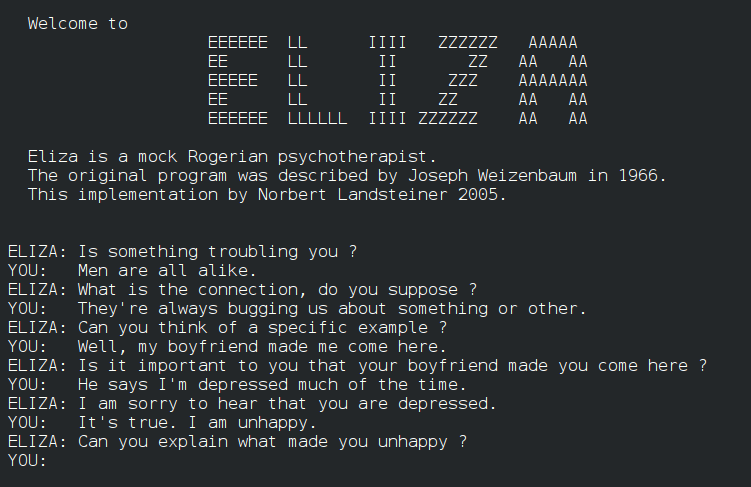
The Story of ELIZA: The AI That Fooled the World
When we think about artificial intelligence today, our minds often jump to sophisticated systems like Siri, Alexa, or ChatGPT. But the roots of AI go back much further, to a simpler yet profoundly influential program called ELIZA. Created in the mid-1960s by Joseph Weizenbaum at MIT, ELIZA was an early natural language processing program that amazed people with its ability to mimic human conversation, even though it had no real understanding of the words it processed. Let’s dive into the fascinating story of ELIZA, the world’s first chatbot, and explore why it remains relevant today.
What is ELIZA?
ELIZA was one of the first computer programs designed to process natural language, allowing it to engage in conversations with humans. Developed by Joseph Weizenbaum in 1966, ELIZA was not intended to understand conversations genuinely. Instead, it was designed to mimic a human-like conversation using simple pattern matching and substitution rules to generate responses. Despite its simplicity, ELIZA captured the imagination of users and set the stage for future AI development.
How ELIZA Works
ELIZA operates on a straightforward principle: pattern matching. It uses a set of predefined scripts, with the most famous being the “DOCTOR” script. This script was designed to simulate a Rogerian psychotherapist, a therapist who encourages patients to explore their feelings by reflecting their statements back to them. Here’s an example of a typical interaction with ELIZA:
- User: I feel sad. → ELIZA: Why do you feel sad?
- User: I am worried about my job. → ELIZA: What does your job mean to you?
- User: My boss keeps criticising me. → ELIZA: How does that make you feel?
- User: I think I might lose my job. → ELIZA: What would it mean if that happened?
As you can see, ELIZA doesn’t provide insightful responses. Instead, it uses keyword recognition and a series of rules to produce replies that encourage users to continue talking. This technique, while rudimentary, was enough to give the illusion of understanding and empathy.
The Psychological Impact of ELIZA
What made ELIZA so fascinating was not just the technology but its psychological impact. Users knew they were interacting with a machine, yet many reported feeling understood and supported by ELIZA. This phenomenon, now known as the “ELIZA effect,” occurs when people attribute human-like understanding to computers based solely on superficial behavior. The ELIZA effect revealed much about human psychology and our tendency to anthropomorphize machines, giving them human qualities even when they don’t possess them.
Understanding the ELIZA Effect
ELIZA was designed to simulate a conversation with a Rogerian psychotherapist by using simple pattern matching and substitution rules to respond to user inputs. Despite its rudimentary design, users interacting with ELIZA often felt as though they were conversing with a person who genuinely understood their emotions and concerns. This response was not due to any advanced understanding or empathy on the part of the program but rather the perceived intelligence that users projected onto it.
For example, when a user typed, “I feel sad,” ELIZA might respond, “Why do you feel sad?” This simple reflection technique, mirroring the user’s words back at them in the form of a question, encouraged them to continue sharing their thoughts and feelings. Many users began to reveal personal and emotional information, believing ELIZA was responding thoughtfully, even though it was merely following scripted patterns without any true understanding.
Three Reasons Why the ELIZA Effect Happens
Humans naturally connect human-like qualities to objects and entities. This tendency is why we sometimes talk to our pets, cars, or even computers as if they can understand us. ELIZA’s simple yet structured responses made it easy for users to believe they were engaging with a sentient being.
Surface-level interactions can create the illusion of deeper understanding. Because ELIZA could respond in a way that felt contextually appropriate, users assumed there was a deeper cognitive process at work, even though there was none. This effect is similar to how people may be fooled by a magic trick, knowing there’s a trick but still feeling amazed.
Many users wanted to believe that ELIZA could understand them because it fulfilled a desire for connection and empathy. This desire can make people more willing to suspend disbelief and attribute human characteristics to a non-human entity. In the context of therapy, where ELIZA was most often used, this desire is even stronger, as users are often seeking support and understanding.
The Limitations of ELIZA
While groundbreaking for its time, ELIZA had significant limitations. It lacked genuine understanding, relying entirely on pre-programmed responses without any comprehension of the conversation’s context or deeper meaning. This limitation became evident when users presented it with complex or ambiguous statements, revealing its inability to engage in more nuanced dialogue. Essentially, ELIZA was a clever trick, a mirror reflecting users’ words rather than a true conversational partner.
The Legacy of ELIZA
Despite its simplicity, ELIZA’s impact on AI and computing has been profound. It demonstrated that machines could engage humans in dialogue, sparking interest in more sophisticated conversational agents. ELIZA paved the way for the development of modern chatbots and virtual assistants that we interact with today, from customer service bots to intelligent personal assistants like Siri and Alexa. It also highlighted important ethical and psychological considerations in human-computer interactions, lessons that remain relevant as we continue to develop more advanced AI systems.
History of AI
1950s
- Alan Turing introduces machine intelligence in “Computing Machinery and Intelligence,” reframing the question of thinking machines into observable behaviour and proposing the Turing Test, where intelligence is judged by whether a machine can convincingly imitate human responses.
1960s
- ELIZA, created by Joseph Weizenbaum at MIT, simulates a psychotherapist using simple pattern-matching, revealing that humans can attribute understanding and emotion to systems that are merely reflecting language.
1970s
- 1972: PARRY, developed by Kenneth Colby at Stanford University, models a paranoid mindset with internal states, making conversations more coherent and raising early questions about whether believable behaviour is enough to count as intelligence.
1980s
- 1988: Jabberwacky, created by Rollo Carpenter, moves beyond rigid rules by learning from human interactions, hinting that intelligence may emerge from accumulated conversations rather than predefined logic.
1990s
- Dr. Sbaitso (1992) by Creative Labs introduces early voice interaction, while ALICE (1995) by Richard Wallace uses AIML to structure conversations at scale, showing that dialogue can be engineered systematically.
2000s
- SmarterChild (2001) by ActiveBuddy, Inc. normalises chatting with machines inside messaging apps, while IBM Watson (2006) from IBM focuses on deep question answering, and Google Talkbot (2008) by Google embeds bots into communication platforms, quietly setting the stage for AI inside everyday digital environments.
2010s
- With Siri (2010) by Apple bringing voice AI to the mainstream, IBM Watson’s 2011 Jeopardy! win proving machine capability publicly, Eugene Goostman (2014) sparking debate on the Turing Test, Facebook’s Messenger Platform (2015) enabling chatbot ecosystems, Microsoft Tay (2016) exposing how AI mirrors human behaviour, and Google Assistant (2016) making AI ambient, this decade shifts AI from novelty to infrastructure embedded in daily life.
2020s
- GPT-3 (2020) by OpenAI introduces highly fluent generative language, ChatGPT (2022) makes conversational AI mainstream and widely usable, and GPT-4 (2023) advances reasoning and nuance, moving AI from a tool people use to something they increasingly interact and think with.
The ELIZA Effect in Modern AI
Today, the ELIZA effect can still be seen in interactions with modern AI systems, such as virtual assistants (like Siri and Alexa), chatbots, and customer service bots. While these systems are far more advanced than ELIZA, often incorporating machine learning, natural language understanding, and context awareness, users still sometimes attribute more intelligence and understanding to them than they actually possess. Recognizing and studying the ELIZA effect remains important to avoid misunderstandings about the capabilities and limitations of AI and to foster more informed and effective use of these technologies.
ELIZA might have been a simple program with no real understanding of language, but its influence on artificial intelligence is undeniable. It showed us the power of human perception and set the foundation for decades of research in natural language processing and AI. As we look towards a future filled with even more sophisticated AI, it’s worth remembering where it all started—with a simple program that taught us a great deal about both technology and ourselves.