Business Data System Analysis
Discovering, Analysing, Modelling, & Specifying User Requirements
Business systems analysis is the elicitation, analysis and specification of the logical requirements from business perspectives, and is seamlessly integrated and organized around a model-driven analysis framework in order to design and build or procure effective computer-based business systems.
Our Business System Analysis training Course provides the critical thinking skills, conceptual knowledge and best practices to rapidly discover, analyze and specify business and user requirements. Participants will gain knowledge of the right approaches, tasks and techniques to define the requirements for business system projects. They will learn about gathering business requirements from users and other stakeholders; analyzing and communicating these requirements; creating models and use cases that describe the requirements; defining business rules and requirements specifications to communicate them to solution developers.
This training course will help potential systems analysts to create and design system processes which will help a company to achieve success. They will also explore a broad spectrum of current techniques that can be used to ensure that systems are comprehensively described and correctly defined.
Objectives
At the end of this training course, you will learn to:
⦿ Understand the Role of the Business Systems Analyst, the Systems Development Life Cycle (SDLC) and How the System Scope is defined
⦿ Understand the importance of system stakeholders and their goals Plan, conduct, and follow up on a structured investigative interview
⦿ Produce a use case diagram and a detailed use case description
⦿ Define System Actor Goals and Convert these to Use Cases Write Effective Business Rules
⦿ Document Functional and Non-functional Business Requirements
⦿ Compile the desirable contents of a Business Requirements Specification Training Methodology
State-of-the-art business systems analysis methods and techniques are transferred by means of short, focused presentations which are followed by experiential learning workshop sessions. In these sessions the knowledge gained is applied to real-world examples and case studies. Rapid learning of the methods and techniques is achieved by means of group work, individual work, participant discussion, facilitator interaction and constructive feedback.
Organisational Impact
⦿ Reduced information technology development risk, costs and time overruns Improved integration of information technology projects with business needs Improved communication between the business and the information technology department of the organisation
⦿ The correct fit between the requirements of the organisation and information systems that are developed or procured
Personal Impact
This training program will provide you with a basic fluency and literacy in a number of core issues that involve business system analysis so that you are better equipped to manage the opportunities and challenges it presents.
Specifically, participants will have:
⦿ Work more effectively in or with a systems development project
⦿ Have the ability to gather elicit business requirements from users
⦿ Be able to comprehensively identify the requirements of the business
⦿ Effectively communicate business requirements to developers
This Business System Analysis training course is designed for the following:
⦾ Business and System Analysts
⦾ Enterprise Architects
⦾ Systems Development Project Leaders
⦾ Systems Development Team Members
⦾ Managers who need to understand more about this vital link between business users and IT systems
Course Outline
Introduction and Business Environment
- ⦿ Understand the role of Business Analysis in System Development Cycle.
- ⦿ Explore alternative approaches to Business Systems Analysis.
- ⦿ Get familiar with the Systems Development Life Cycle (SDLC).
- ⦿ Learn how to initiate a Systems Development Project.
- ⦿ Identify System Users and Stakeholders.
- ⦿ Create a Vision Statement and define System Scope.
System Modeling
- ⦿ Introduction to Systems Modeling Concepts.
- ⦿ Explore Enterprise Architecture Modeling.
- ⦿ Learn about Normalization in modeling.
- ⦿ Understand System Context Modeling.
- ⦿ Study System Scope Modeling.
- ⦿ Learn Use Case Modeling.
- ⦿ Model Information Requirements.
Gathering and Communicating Requirements
- ⦿ Plan, conduct, and follow up on structured investigative interviews.
- ⦿ Utilize workshops, brainstorming, surveys, questionnaires, document analysis, observation, and interface analysis for requirements gathering.
- ⦿ Learn about random sampling.
Writing Effective Use Cases
- ⦿ Gather User Stories.
- ⦿ Define Actors and Actor Goals.
- ⦿ Convert Actor Goals into Use Cases.
- ⦿ Document detailed Use Case Descriptions.
- ⦿ Refactor Use Cases.
- ⦿ Maintain the Data Dictionary.
Developing Requirements Specification and Validation
- ⦿ Understand the value of effective requirements gathering.
- ⦿ Learn to write Business Rules.
- ⦿ Document both Functional and Non-Functional Requirements.
- ⦿ Prepare the Requirements Specification.
- ⦿ Verify and Validate Requirements.
- ⦿ Write Test Cases.
- ⦿ Learn how to present your Requirements Specification.
Business Data System Analysis
Investment & Recognition:
- Program Cost: (50GBP including certification)
- Discount Opportunities: (Corporate Packages are available for 5+ users – contact info@londoninterculturalcenter.co.uk)
- Payment Options: Secure payment gateway through Stripe or Paypal – Multiple cards accepted including Visa, Master and American Express
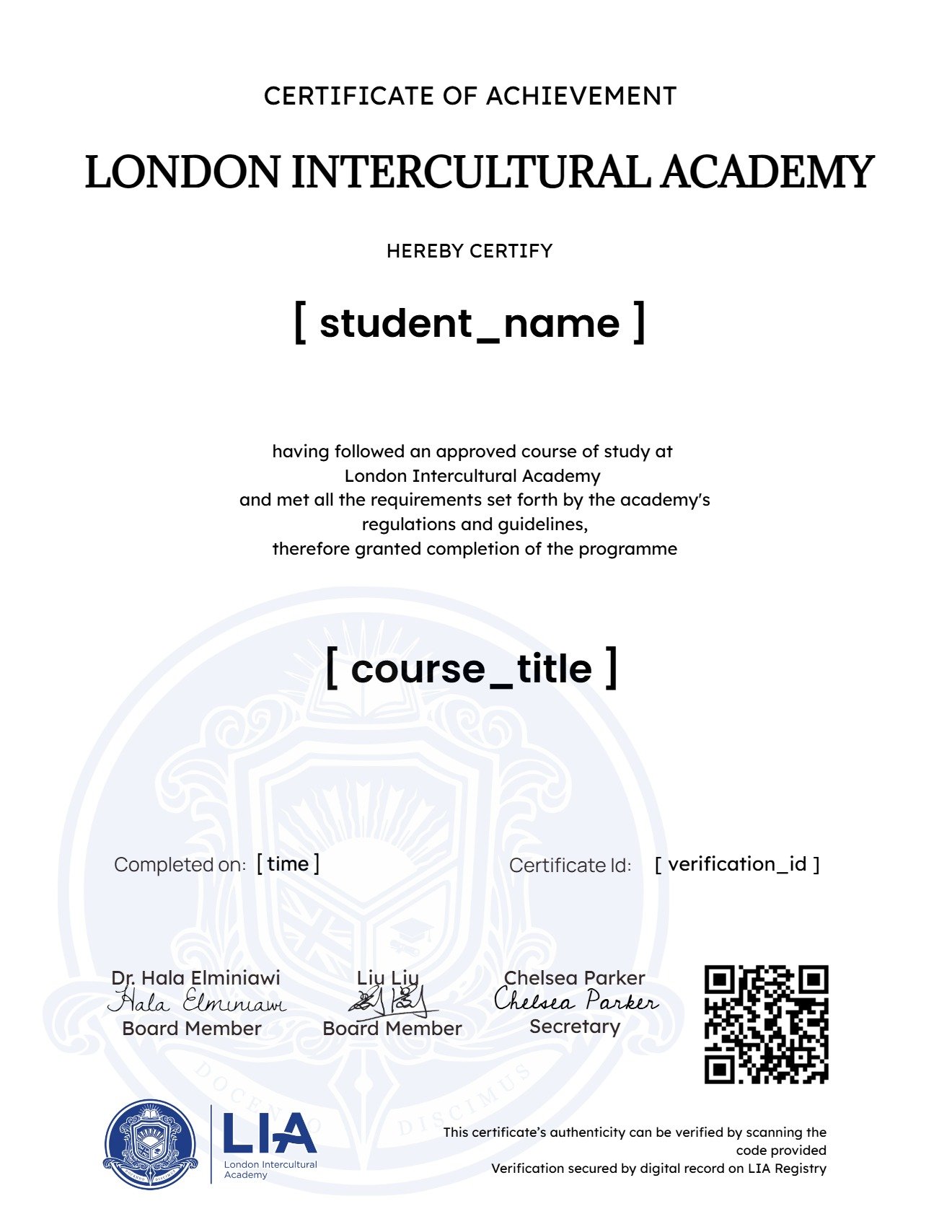
- Completion Recognition: London Intercultural Academy’s Certification is included upon completion of this course
- Alumni Support: Full support during working days/hours – Monday to Friday – 9am to 5pm GMT


Scarlet Livingston
This course has changed the way I used to look at things, this is one of the courses that I have taken and loved with London Intercultural Academy, the program is easy to digest and fun to watch
What I will learn?
- Understand the pivotal role of Business Systems Analyst.
- Comprehend the Systems Development Life Cycle (SDLC) and its application.
- Master Systems Modeling Concepts.
- Explore Enterprise Architecture Modeling.
- Learn about Normalization in modeling.
- Understand System Context Modeling, System Scope Modeling, and Use Case Modeling.
- Model Information Requirements.
- Plan, conduct, and follow up on structured investigative interviews.
- Utilize various techniques including workshops, brainstorming, surveys, questionnaires, document analysis, observation, and interface analysis for requirements gathering.
- Learn the concept of random sampling.
- Gather User Stories effectively.
- Define Actors and Actor Goals.
- Convert Actor Goals into detailed Use Cases.
- Document and refactor Use Cases.
- Maintain the Data Dictionary.
- Understand the value of effective requirements gathering.
- Write clear and effective Business Rules.
- Document both Functional and Non-Functional Business Requirements.
- Compile a comprehensive Business Requirements Specification.
- Verify and validate requirements.
- Write effective Test Cases.
- Develop skills to present a Requirements Specification.
- Grasp the importance of reduced IT development risk, costs, and time overruns.

- Improve integration of information technology projects with business needs.
- Enhance communication between business and IT departments.
- Develop a basic fluency and literacy in core issues related to business system analysis.
- Acquire skills to work effectively in or with a systems development project.
- Gain the ability to gather and elicit business requirements from users.
- Enhance the capability to comprehensively identify the requirements of the business.
- Improve communication of business requirements to developers.
Course Curriculum
Business System Analysis
-
Module 1
00:00 -
Module 2
00:00 -
Module 3
00:00 -
Module 4
00:00 -
Module 5
00:00 -
Module 6
00:00
Certificate Included
Complete the course and receive a certificate you can add to your CV and LinkedIn profile
Material Includes
- With a total duration of 40 minutes, this course is designed to provide you with concise, impactful lessons that you can implement immediately, Your enrollment grants you unlimited access to the course for a full 30 days. Dive into the material whenever and wherever you please
Target Audience
- Business and System Analysts
- Enterprise Architects
- Systems Development Project Leaders
- Systems Development Team Members
- Managers who need to understand the link between business users and IT systems
Partner with LIA to implement our framework at your company
This programme is also delivered in-person for organisations across the UK, Europe, and the Middle East.
Bring This Training to Your Organisation
-
LevelAll Levels
-
Enrollment validityEnrollment validity: 30 days
-
CertificateCertificate of completion
Modular
Short structured lessons
Hybrid
Online or in person delivery
Credentialed
Awarded upon completion
Trusted by Professionals Across Industries
Our programmes are used by professionals and teams across 40+ countries dealing with real-world complexity.
For Talent Development
We offer structured support for organisations and teams seeking sustained behavioural and professional growth.
Partner with LIA to implement our framework at your company
Our Learners are Successful and Thriving

LIA’s programs are highly interactive, ensuring participants are fully engaged and able to apply the learnings in real-world situations. We are proud to collaborate with such a forward-thinking platform that continues to set the standard for excellence in cultural training.
Carol Constant - Founder @ Whomlab

It's effortless & enjoyable learning, straight to the point and loaded with practical goodies. Lot's of interesting and helpful courses to choose from, addressing all kinds of issues from Artificial Intelligence to Wellbeing & Health.
Dr. Britta Simon - HeartMath Institute

As a leader committed to fostering diverse,equitable and inclusive workplaces, I highly recommend the LIA as a premier online destination for professional and leadership development.
Maria Drueco - CEO @ Inclusive Journey

Excellent courses on a variety of relevant topics important in today’s corporate world. All courses provide you a certificate too which is great. Good customer service too
Amin Farid - Officer @ Court of Justice

As an experienced leader I maintain a curiosity for new ideas. The Transitioning into Leadership course was a useful refresher which gave me new ideas for my executive coaching work
Richard Thickpenny - Co-Founder Green Action International
Frequently Asked Questions
Our programmes are designed for professionals, leaders, and organisations seeking meaningful development.
They are particularly suited to those navigating complexity: diverse teams, evolving workplaces, and high-stakes decision-making.
Most courses transfer knowledge.
These programmes are designed to reshape perspective.
The emphasis is on application, reflection, and behavioural change, ensuring that what is learned is carried into practice, not left behind at completion.
Yes.
Organisations often find the greatest value when teams engage collectively, creating shared language, alignment, and more effective collaboration.
Tailored solutions are also available for organisational contexts.
Participants who complete a programme will receive certification from London Intercultural Academy (LIA).
Access is provided immediately upon enrolment.
Participants may begin at a time that suits their schedule.
Programmes are designed to integrate into demanding schedules.
While the time investment is modest, the expectation is thoughtful engagement rather than passive consumption.
Participants have access to guidance and support to ensure a smooth and meaningful learning experience via support@liacademy.co.uk
We offer a range of formats designed to suit different needs, including online courses, in-person programmes, live virtual sessions, and blended learning journeys.
Yes.
We deliver in-person workshops, team sessions, and executive programmes, either on-site or at selected venues.
These are particularly effective where interaction, alignment, and real-time discussion are essential.
-
LevelAll Levels
-
Enrollment validityEnrollment validity: 30 days
-
CertificateCertificate of completion